The resistivity of a paint or varnish directly influences the performance of electrostatic painting systems. Accurate measurement enables the optimisation of material transfer, improves the quality of the finish and reduces paint consumption. The ASTM D5682 standard establishes a recognised method for assessing the electrical resistivity of these liquid products.
What is the resistivity of a paint?
Resistivity is an electrical property that indicates a material’s ability to resist the flow of electric current.
In the case of liquid paints and varnishes, this parameter is particularly important when using electrostatic application systems, as it directly influences the way in which paint particles respond to the electric field generated during the spraying process.
A suitable resistivity helps to improve transfer efficiency and the uniformity of the applied coating.
Why is it important to measure resistivity in electrostatic painting?
Electrostatic painting systems rely on the attraction between electrically charged particles and the workpiece to be coated.
When the paint’s resistivity is not within the appropriate range, problems such as the following may arise:
- Reduced transfer efficiency.
- Increased paint consumption.
- Less uniform finishes.
- Increased overspray.
- Increased waste and operating costs.
For this reason, periodic measurement of resistivity forms part of routine quality control in many industrial painting processes.
What is the ASTM D5682 standard?
The ASTM D5682 standard is a test method used to determine the electrical resistivity of paints, varnishes and other liquids used in electrostatic application systems.
Its aim is to provide a repeatable and reliable procedure that allows results to be compared and ensures that the product retains the properties necessary for correct application.
The use of standardised methods also facilitates the traceability of measurements and comparisons between different production batches.
How is a resistivity measurement carried out?
The procedure is relatively straightforward.
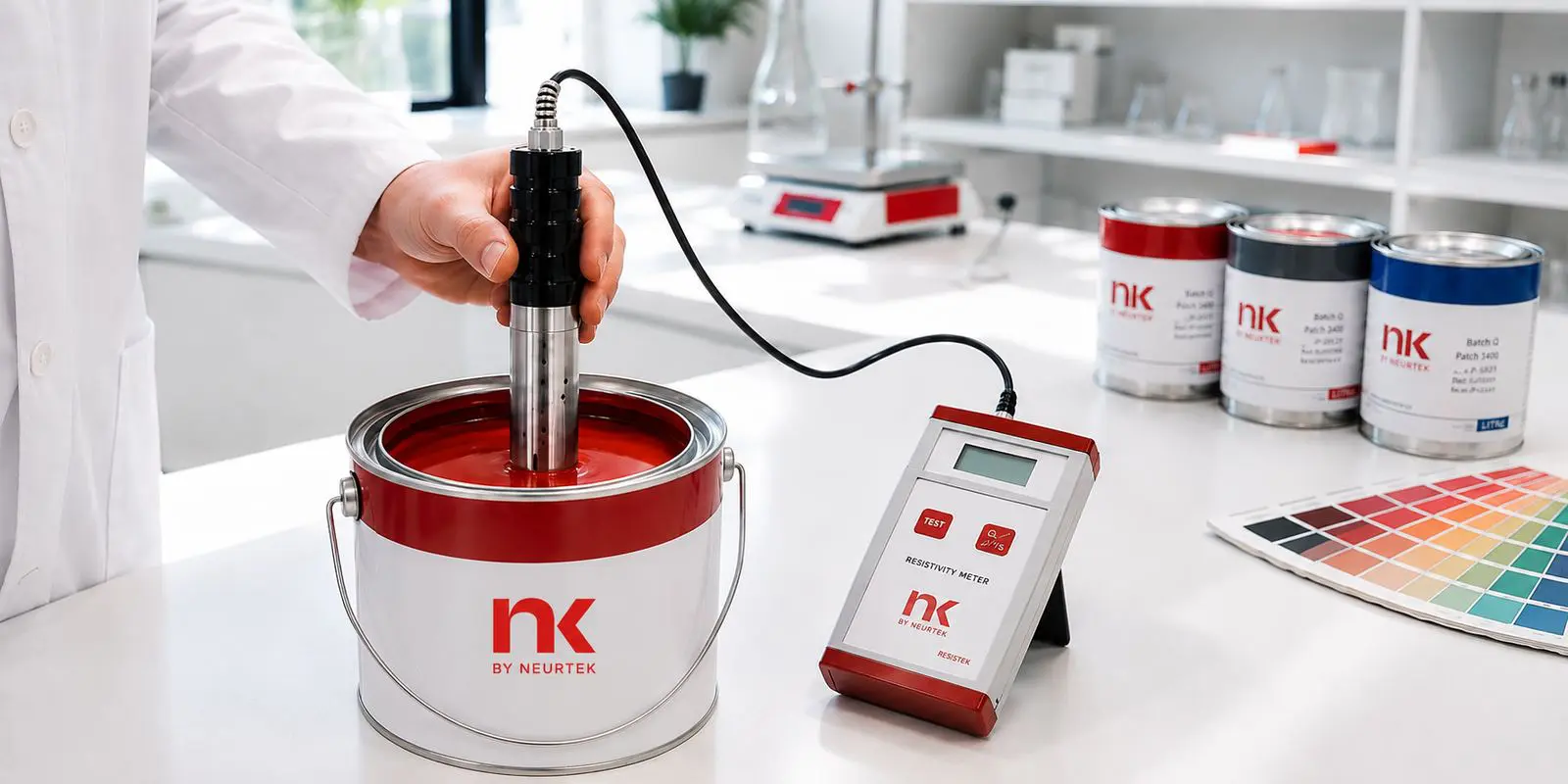
- The probe is inserted into the liquid sample.
- The equipment applies the established measurement methodology.
- The resistivity value is obtained.
- The result is compared with the values defined by the process or internal specification.
The speed of the measurement allows for regular checks to be carried out both in the laboratory and on the production floor.
Benefits of monitoring the resistivity of paints and varnishes
Resistivity measurement offers direct benefits in terms of process quality and efficiency:
- Greater transfer efficiency. It enables the optimisation of the amount of paint applied to the workpiece.
- Reduced material consumption. It helps to minimise losses and waste during application.
- Improved finish quality. Promotes a more uniform distribution of the coating.
- Greater process stability. Facilitates the early detection of variations between batches.
- Lower environmental impact. Reduces paint consumption and waste generation.
Common applications
Resistivity measurement is commonly used in:
- The manufacture of paints and varnishes.
- Electrostatic painting systems.
- Quality control laboratories.
- Industrial coating lines.
- Manufacturers of metal components.
- Automotive industry.
- Industrial paint applicators.
RESISTEK: fast and reliable resistivity measurement in accordance with ASTM D5682
To carry out this type of testing, NK by NEURTEK has developed the RESISTEK digital resistivity meter.
This equipment enables the resistivity of paints and varnishes to be measured quickly and easily, helping to optimise the performance of electrostatic application systems.
Its main features include:
- Compliance with ASTM D5682.
- Measurement range from 100 kΩ to 20 MΩ.
- Automatic scaling.
- Direct digital readout.
- Portable and lightweight design.
- Certified calibration available.
Thanks to its ease of use, the operator can obtain a result in approximately 10 seconds, facilitating routine production and laboratory checks.